Meh
A review of Antinatalism, Extinction, and the End of Procreative Self-Corruption

This essay is a review of the Häyry/Sukenick book Antinatalism, Extinction, and the End of Procreative Self-Corruption. It was first published on February 21 2024 as a quickdraw review of the book, giving my initial impressions of things that stood out to me after a first reading. An archive can be found here. The essay in its current form (August 5 2024, archived here) is an overhaul after some Q&A with Matti Häyry, after contacting Corey Anton about how his views were misrepresented, and after thinking deeper and connecting dots I missed first time through.
𝄢
1: “No major English dictionaries cover the term (Antinatalism)” (p11)
Antinatalism is defined in the Cambridge English Dictionary. Sukenick released a video on January 1 announcing the book. At first glance this appears to be at odds with the p1 quote, but it can probably be squared away by copy deadlines having already passed. The point here is simply to note that at least one major English dictionary does now define antinatalism.
𝄢
2: Section 1 (pp4-25) provides an overview of AN type thought throughout history, making the case that the history of Western philosophy can be regarded (dismissed?) as a reaction to antinatalist thought. I found it tedious. Knowing what I know about Sukenick and her main character syndrome (she declared herself the spokesman for AN), it comes across to me as if the authors are saying it’s always been AN against the world and they’re the latest in a long line of custodians keeping the flame from extinguishing, holding the darkness at bay.
Can western philosophy be reduced to what the authors describe as a "Struggle against Antinatalism" (p4)? I don't think so. Is there evidence of AN type thought in philosophy? Yes, but arguments can be successfully mounted for western philosophy being a struggle against whatever ideology one wants to spruik. Like the authors the nazis also used Nietzsche to lend credibility to their ideology. To be clear, I'm not associating the authors with nazism2. I'm simply making the point we need to be cautious about retconning the history of philosophical pessimism through the eyes of this nascent breed of antinatalist activists.
This isn’t the first time the history of antinatalist thought has been explored. If this is something you want to dig into I recommend other authors such as Coates and Lochmanova. Even better, acquaint yourself with original writings instead of having your opinions molded by second hand reporting. Your opinion about what anyone has said counts for nothing if it’s based on what someone else has told you what they said. A ton of philosophical literature is available for free online, including audiobooks if reading isn’t your thing (As is the case with most people involved in online AN).
𝄢
3: “the moral wrongness of reproduction seems to be at the core of at least most academic attempts to analyze and assess antinatalism” (p1)
Conversely, attempting to separate AN from moral wrongness is mostly a social media phenomenon, with sentiocentric (vegan) and efilist ANs leading the charge. Theirs however is bald and belligerent insistence, in contrast to academia where ideas are posited and arguments defended in compliance with the rules of engagement.
Moral wrongness being at the heart of AN creates a problem for sentiocentric and efilist antinatalists like Sukenick because it invokes moral agents, necessarily restricting AN to human procreation3. What I find curious about this book (and the other paper Sukenick co-authored with Häyry) is the focus on human procreation. This is odd in light of Sukenick's obsession with efilizing AN from within and turning it into a social movement dedicated to eliminating all sentient suffering. I’m surprised she hasn’t used this opportunity to formally make her case. Is this a thin edge of the wedge strategy to get her foot in the door with the motte before unveiling the bailey, or has she finally come to the realization that separating AN from moral wrongness is more complicated than simply saying so?
𝄢
4: “The justifications presented for antinatalism offer a wide range, too. Population growth degrades the natural environment. The world is a bad place and should not be more populated. Reproduction requires sex and sex is a sin. Our children’s lives would be bad. We do not have their permission to bring them into existence. Life is suffering and we should not contribute to its continuation. Children are a burden. Children are a nuisance. Men are evil. Women are evil. Human beings are evil. Humankind inflicts suffering on other species. My life sucks. I wish I were dead. I wish I had never been born. My life has no meaning. Human life has no meaning. Life has no meaning. And to these we can add a plethora of religions and schools of thought. It is, to say the least, a mixed bag.” (p1)
These are reasons people give for choosing not to have children. Not having children isn't the same as subscribing to AN. Such justifications point to AN being conditional depending on the presence or absence of specified constraints4. This is fast heading towards AN being defined as Not necessarily in favor of procreation, depending on which way the wind's blowing. If AN equals conditional proscription of procreation, then everyone's an antinatalist because aside from extreme outliers who insist on an irrevocable duty to bring as many people as possible into existence, everyone probably has a line where they'd say procreation is unacceptable. For example, most people can no doubt imagine a deformity or environmental state which would compel them to proscribe procreation in every such instance. Does this make everyone AN? No, of course not. But if everyone is AN, as conditional proscription implies, then there isn't any need for AN activism or content, including this book.
Also cf p28: "Pearce has a solid followership on social media, and he is an antinatalist in the sense that he is childless and recommends it to others, as well". This implies being childless and recommending childlessness to others amounts to being AN. Is this carelessness or are Häyry and Sukenick intentionally expanding the scope of AN? Why try to spread AN so thin? Is it gerrymandering to create the false impression of growth and influence? Is it to make AN more palatable by watering it down for those who balk at unconditional proscription?
𝄢
5: “Karim Akerma, an undeservedly neglected pioneer of turn-of-the-millennium antinatalism” (p27)
Akerma’s considered important in some AN circles because he's a vegan extinctionist—ie he has the right opinions. As for why he may have been neglected within the broader ANosphere, it’s probably because he’s a low resolution thinker. As for why he hasn’t made it outside of AN circles, that might have something to do with the fact he’s an academic fraud. One part of Akerma’s history his fanbase ignores is the real reason for why he was one of the very rare candidates whose habilitation was rejected. He failed to meet the required academic standards. But instead of being honest about this, he fabricated an antinatalist victimhood narrative to cover up his failure, peddling the asinine falsehood that he was rejected because of his antinatalism beliefs (which he milks for sympathy). Sukenick et al nod along like lemmings and run with it. Oh well, the current crop of AN activists are happy to tolerate CSAM advocacy from within their ranks5, so my expectations are already well below the waterline.
𝄢
6: (A) “Others who call themselves antinatalists, however, have mitigated the connection (between AN and extinction), to the point that they sometimes seem to be in denial about the fate of the species if reproduction should stop.” (p27)
(B): “many members of the antinatalist social media community seem to abhor the idea of human extinction, or being responsible for it, or being seen to be responsible for it.” (p28)
Unmitigated bullshit. Not only are these unevidenced claims, Häyry is unable to provide evidence when asked. Sukenick linked to the book on January 1 2024. When I asked Häyry to substantiate these claims he linked to a video posted on May 20 2024, I informed him the video was published 5 months after the book was released, and again asked him to substantiate the claims. He then referred to Lawrence Anton’s quote on p29, “Should the extinction of humans be the or a goal of an anti-procreative movement, and if so why? So my view on that is that, I don’t think it’s necessary to have it as a goal, I think an anti-procreative movement should be what it says on the tin – it’s anti-procreation rather than pro-extinction. Even though being anti-procreation will very likely practically lead to extinction, I think there’s an important difference between being anti-procreative and pro-extinction.”. That doesn’t prove the claims.
This is extraordinary. Häyry first cites a video published 5 months after the fact to prove his claims, then cites a comment that doesn’t have any probative bearing whatsoever on the claims. Fucking hell.
What makes it even more extraordinary is a 2015 paper published by Häyry6 with the title “What Exactly Did You Claim? A Call for Clarity in the Presentation of Premises and Conclusions in Philosophical Contributions to Ethics” in which he critiques a paper examining “how exactly it fails to meet the requirements of clarity” (p107). On p112 he states, “authors should state explicitly what they mean by their arguments and what they claim in their contributions to philosophical ethics”. Häyry has failed when measured against his own standards.These are two of the falsehoods Sukenick regularly trots out to dump on non-efilist-ANs who aren't gung ho about extinction or who aren’t on board with efilism. Those of us familiar with the history of online AN over the past two decades know Sukenick’s full of shit and she’s trying to rewrite things to cast herself as the hero who saved AN from itself. Her, Häyry, and others are exploiting the ignorance of newbies in the AN space whose only insight into AN and into the past is what these miscreants tell them. To steal from Twain, “If you don't learn from Sukenick, you're uninformed. If you do learn from Sukenick, you're misinformed.”
Re (A): I don't know of any AN in denial about extinction being the inevitable upshot of everyone subscribing to AN, nor of any AN trying to mitigate the connection. The two actual points of contention are:
(1) Whether or not wanting to bring about extinction is a reason for subscribing to AN. Extinctionists view AN as something to be instrumentalized for the purpose of helping bring about extinction while others view extinction as incidental to AN, something to be weighed up as an objection to AN. Nothing to do with denial or mitigation. Interpreting the latter as denial or mitigation means Sukenick’s engaging in bad faith or she’s incapable of engaging ideas at this level.
(2) Sukenick sometimes uses extinction and efilism interchangeably for the purpose of gaslighting. If an AN who isn’t an efilist objects to efilism, she’ll covertly poison the well by saying That means they’re against extinction, which is strange for an AN. But being against efilism isn’t the same as being against extinction. In reality non-efilist ANs want to mitigate, if not eliminate, connections with efilism, not extinction, for reasons discussed momentarily.
Re (B): I've never seen any AN say anything that could be interpreted as abhorring the idea of human extinction, or trying to avoid being seen as responsible for it7. Speaking for myself, accepting extinction as a consequence of AN doesn’t mean I don’t lament it. I’m inspired and awed by the hopes and dreams which possess humanity. Wouldn't it be wondrous to see how much we can accomplish, how far we can go, and participate in the adventures we could have? There's a part of me that feels sorrowful knowing humanity will end at some point in time (I'm a very bad pessimist). But that's a far cry from abhorrence.
As for responsibility, what does it mean to say many members of the antinatalist social media community seem to abhor the idea of being responsible for, or being seen to be responsible for human extinction? Where has this sentiment ever been expressed or implied apart from this book? Of course no examples are given. Because none exist. Sukenick just makes shit up as she goes. ANs publishing social media content or not having kids doesn't make ANs responsible for extinction, and it’s readily accepted within AN circles that AN will never gain mainstream traction. The only way I can come close to making sense of this is to wonder if Sukenick might be expressing a belief that being perceived as responsible for extinction prevents ANs from engaging in activism. This is reaching, but the statement has to mean something and this is the best I can come up with to make sense of it.
The only times I've witnessed abhorrence at taking responsibility is when efilists have tried to weasel their way out or seek retribution after being called out for saying objectionable things. The most notable example is Gary Mosher8 and Sukenick trying to retcon his CSAM statements here and here respectively. Another example is Mosher going on a rant about how he'd kill a woman if she chose to have his child after an accidental pregnancy due to contraceptive failure, then lying by saying he merely suggested women should be punished for poking holes in condoms and stealing a person's genetics9. Then there's the ongoing retaliation campaign from John Madore10 after I drew attention to such comments as, "If someone tried to use my sperm/DNA to have a baby I'd kill them"11, "The killing of a pregnant woman is justified in preventing the birth of sentient (sic) creature you directly had a hand in creating"12, and "There are certain situations where I could see myself being driven to do that" in response to the question Can you rape/torture a woman for months if that meant she wouldn't give birth to a single child?13.Contrary to what Sukenick asserts, the actual points of contention are rejecting the argumentation giving rise to efilism's positive duty to bring about extinction BAMN, and the brutality at will efilists routinely advocate for as ethically justifiable if not ethically obligatory14. That's what non-EF-ANs find abhorrent. That's what non-EF-ANs want to deny any association with. Sukenick will avoid this discussion at all costs because getting into it would require acknowledging her responsibility for Mosher, efilists, and efilism gaining a foothold in online AN. She knows this will negatively impact her aspirations going forward so she’ll deny and downplay no matter how much she has to lie and deceive.
Häyry reinforces this fable in a subsequent video interview where he says, “(Extinction's) the elephant in the room of contemporary antinatalism. We know that it's there but no one wants to talk about it. If no one has children then humankind will cease to exist, fact. But many people who call themselves antinatalists either deny this or try not to talk about it. The idea seems to be too frightening."15. Does Häyry not comprehend how embarrassing this is for him, especially as an academic? He’s telling the world he uncritically accepts what Sukenick tells him, which is a bad move given how often she lies and how adept she is at manipulating people. Is it because he got sucked in by Sukenick telling him he’s one of the greatest antinatalists of all time?
𝄢
7: The authors chart the concept of selective pronatalism on p30, a term introduced on p2: “Doctrines that claim to be antinatalist have taken conflicting approaches to this matter, leaving both academics and the budding social movement perplexed and uncertain of what exactly is being promoted. Some so-called conditional versions of the creed have retracted from the extinctionist conclusion and settled for temporary or directed condemnations of reproduction. Without claiming linguistic authority on the definition, we argue that these philosophies could best be called selective pronatalism.”
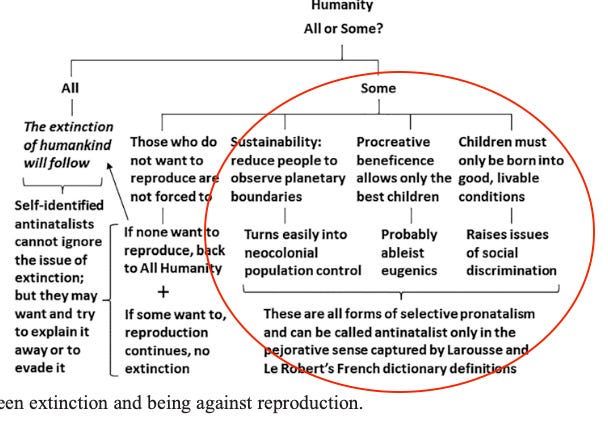
Sukenick and Häyry seem to be very strongly hinting that anything short of unconditional universal proscription of procreation isn’t antinatalism. This is at odds with most of the justifications presented for antinatalism on p1 (cf Section 4 herein) which according to their own criteria, are mostly selective pronatalism. You can't cite “My life sucks. I wish I were dead. I wish I had never been born. My life has no meaning.” in support of antinatalism if you categorize it as unconditional universal proscription of procreation. Those kinds of justifications fall under selective pronatalism as they only apply on a case by case basis and can simply be overridden if one's personal circumstances improve. Sukenick and Häyry need to pick a lane.
The authors’ selective pronatalism resembles my conditional pronatalism detailed in Section 3 of my Defense essay published October 23 2019. The express purpose of my Section 3 is identical to Sukenick and Häyry’s, viz., separating "so-called conditional versions of the creed (and) temporary or directed condemnations of reproduction" from antinatalism proper. Their 3 categories mirror the final 3 examples I give in Section 3 of my Defense:
S&H - “Sustainability: Reduce people to observe planetary boundaries. Turns easily into neocolonial population control.”
SG - “China's 1 child policy is usually referred to as antinatalist. However it was conditional pronatalism in the form of strategic population control, the CCP deciding it needed to control the size of China's population. That it was conditional pronatalism is confirmed by the policy being applied differently depending on region, social status, gender, and by the fact the policy was changed to reflect new conditions in January 2016.”S&H - “Procreative beneficence allows only the best children. Probably ableist eugenics.”
SG - “CRISPR is going to make it possible to alter DNA in-utero. In the future, CRISPR might make it morally reprehensible to bring a handicapped person into existence. Although in such cases, the welfare of the people being brought into existence is centerstage like AN, the debate will proceed on the basis that procreation is a good, meaning it falls under the PN umbrella.”S&H - “Children must only be born into good, livable conditions. Raises issues of social discrimination.”
SG - “Alexandria Ocasio-Cortez queried the ethics of bringing new people into existence in the face of climate change. People called her an antinatalist when in fact her line of questioning confirmed her as a conditional pronatalist in that she was asking about where to draw the line when it comes to determining whether or not climate conditions are un/acceptable for bringing people into existence.”16
Häyry confirmed he read my essay on December 20 2022. He claims the earliest example of him discussing selective pronatalism in the context of differentiating it from antinatalism was a couple of years before this video. The research proposal described in that video doesn't seem concerned with discussing selective pronatalism in the context of differentiating it from antinatalism, but even if we grant it does that only gets us to January 2021, more than a year after I posted my essay.
It’s unlikely Häyry's research proposal was concerned with conditional pronatalism in the context of differentiating it from antinatalism. It's more likely he encountered conditional pronatalism in that context for the first time when he read my essay in December 2022, three years and change after it was published. There’s too much overlap of the 3 examples cited in this book and the 3 examples I give in my essay to wave away the similarities as mere coincidences. It's also impossible that Amanda wasn't familiar with my essay prior to the book being written.Häyry and Sukenick present what they call the Omelas Argument (p48): “Opponents of the risk argument tend to think in terms of just one generation. There is a danger that my child’s life turns out to be bad; but if I can avert this danger, all is well and my reproductive project is safe. But, as far as my choice is concerned, my children will also have children, who will have children, and so on ad infinitum. And after a sufficient number of reiterations during the next decades, centuries, and millennia, with certainty, someone will have a miserable life. That someone is the Omelas child. That child is required for the happiness of everyone else in between and beyond. And this is how my decision to have one child makes me the one who creates Omelas.”
This has been a staple of online antinatalist discourse since forever yet the dynamic duo fail to acknowledge this, presenting it as their creation. Sukenick is terminally online and she has to be aware she’s lifted this from stuff she’s encountered. It isn’t something that can be attributed to any specific individual, but it’s deceptive to not at least acknowledge this isn’t an original line of argumentation.I won't go as far as accusing the authors of plagiarism. But I will say it's suspicious in light of the fact these aren’t the only such examples. Their so-called new argument for antinatalism, the argument from imposition looks very much like Julio Cabrera's manipulation which lies at the heart of his fundamental ethical articulation. When I queried him about this, Häyry responded, “Further study and personal communications with Julio Cabrera have shown that our approaches are pretty similar. The difference, if any, is that he may include the prenatal imposition on non-existing beings in his tool box more readily than we do.”. “The difference, if any...” is another way of saying they're basically the same thing.
Häyry also called one of his articles "Confessions of an Antinatalist Philosopher". It’s tough not thinking he ripped that off Jim Crawford's book “Confessions of an Antinatalist”.
How many dots do you need before a picture begins to form? Häyry and Sukenick would be well advised to tread very carefully when it comes to lifting other people’s ideas and publishing them as their own.
𝄢
8: “Matti Häyry, recognizing that people do not generally acknowledge Inmendham and Benatar’s grim take on life’s value... Following Anton’s lead, they can simply say that what Cabrera, Inmendham, Benatar, and Häyry call a burden is just what human life is... Every human life can be expected to contain episodes of severe pain and anguish, a fact also well recognized by Inmendham and Benatar.” (pp44-45)
Here we see Mosher being grouped with professional heavyweight philosophers, adding plausibility to what I said about Häyry’s and Sukenick’s Argument From Imposition: “It’s transparently an attempt to launder Gary Mosher into legitimacy via academic citations. Look out for future claims from efilists about efilism being accepted as a legitimate philosophy because this paper is cited”.
Mosher’s a youtuber who posts meandering rants raging against whatever happens to get on his nerves. Word on the street is that he’s posted at least 10,000 videos over the last 20 or so years, earning him a cult following of obsessively militant acolytes. There’s no denying he occasionally hits the mark with his rhetoric, but this isn’t surprising. It’s a numbers game. It’d be more surprising if he didn’t sometimes turn a phrase or two with that many videos and years under his belt. However, even after all that, he hasn’t contributed anything novel or advanced discourse in any meaningful way. His popularity stems not from what he says but from how he says it. From the man himself: “It's not so much about the character of the argument, the quality of it, the detail of it, the strength of it. Even as an intellectual thing, the integrity of it. It's more about personality.”
Sukenick is Mosher’s most obsessive fan. Very long story short, she’s made it her life’s mission to spread Mosher’s message far and wide. This is why she hitched herself to Häyry’s wagon17, to launder Mosher into academia via citations. Mosher’s inclusion isn’t because of his contributions. It’s because he happens to agree with some of the things the big hitters have said18 and because he lucked out with Sukenick as his sponsor.Lawrence Anton also gets quoted and referenced several times19. This is a guy who only three years ago boasted about being someone who doesn’t read and who, frankly speaking, lacks competence when it comes to navigating philosophical ideas and argumentation. Once again, he’s a youtube “activist” who hasn’t himself advanced anything novel or added anything of value to AN discourse.20
From p41: “A note on our sources in this section is in order. We have used – in addition to philosophical texts – manifesto passages, church teachings, academics’ personal opinions, and excerpts from an activist’s musings. This has been a deliberate choice. The question of antinatalism and extinction is approached within the community in terms of this kind of material more than technical philosophy and peer-reviewed research contributions.”
Rather than “technical philosophy and peer-reviewed research contributions” it’s apparent most people involved in the online ANosphere get their information from youtube, reddit, discord, and other unvetted sources21. Hardly conducive to rigor. Yet this book is marketed as peer reviewed academic literature by leading scholars22 about the topic of antinatalism, extinction, and the end of procreative self-corruption. Readers have every right to assume citations are from reputable and vetted sources—especially individuals and institutions who fork over USD65 for the hardback version. Discussing Mosher in the same breath as Cabrera and citing your social media mates violates that expectation.
This wouldn’t be a problem if the book was marketed as a non-academic essay about the online extinctionism movement (which the p41 mea culpa confirms the book actually is). Social media activism published under the color of academic standards is a dick move. Institutions such as Cambridge should be more vigilant or drop the pretense of being academic publishers.They should also be more vigilant about who they appoint as editors. Häyry’s listed as Associate Editor of Cambridge Quarterly of Healthcare Ethics. I wonder if Cambridge knows he publicly admits to becoming an editor to game the system so he can bypass normal publishing protocols to get his work published (which judging by the poor quality of this book makes me wonder if that’s what happened here). I wonder if him being Associate Editor of CQHE had anything to do with CQHE’s Editor Thomasine Kushner suggesting turning an article submitted by him and Sukenick into a book, and with Kushner becoming the book’s editor (Notice how in Sukenick’s origin story she gives the impression interest in the book was organic while leaving out the fact Häyry being CQHE’s Associate Editor most certainly played a part in the book being accepted for publication. Organic interest my arse. More like conflict of interest.). The barbarians never leave once you let them in.
𝄢
9: “Some human lives can be expected to be truly miserable, a fact verified in a legal sense by successful wrongful life cases.”
According to his wikipedia page Häyry was Professor of Bioethics and Philosophy of Law at the University of Manchester in England from 2004 until 2013. Yet he believes parents can be defendants in wrongful life cases, as confirmed by his comments elsewhere:
- “This kind of thinking has been contested on factual grounds in debates concerning voluntary euthanasia and the so-called wrongful life cases. Even conservative philosophers have admitted that some circumstances can make life unbearable. And the lawsuits brought against parents and the medical establishment by severely disabled individuals seem to prove that they do not particularly value their own existence.”23
- ”People who root for reproduction, pronatalists24, tend to think that the value of life ranges from very good, full positive, to close to zero. Most lives however are very good or at least quite good and the lower end is an exception, maybe the case when rare individuals claim to have truly horrible wrongful lives and sue their parents for being alive.”25
This is inexcusable for a guy with a decade long stint as a philosophy of law prof who focuses on AN related topics. Someone with that on his CV should know parents aren't defendants in wrongful life cases. It's the equivalent of a 10 year finance professor saying assets should be listed as liabilities. This isn’t a trivial concern. There’s something wrong with someone who gets something this wrong. Any bona fide legal academic or lawyer would be laughed out of the room if they published such drivel. Well, to be fair, no bona fide legal academic or lawyer would make such an error.
Or I could be wrong. There could be jurisdictions with wrongful life actions permitting for parents to be defendants. I invite Häyry to prove me wrong by tabling them26.
𝄢
10: “Although we (the authors) understand and appreciate the arguments from lack of consent, manipulation, low quality of life, and risk, the reality is that something in them has, at least so far, prevented them from gaining widespread acclaim.” (p45)
This is because whether or not someone subscribes to AN doesn't have anything to do with muh arguments. There's a difference between agreeing with the argumentation leading to “procreation is unethical” and subscribing to that conclusion as an AN. I've presented the consent argument to people who readily accept it. Yet they don't subscribe to AN while I do. Why? Because the intuitions and predispositions underlying our worldviews aren't based on reason. They're based on a multitude of interconnecting nature-nurture factors which form layer upon layer over a lifetime, the most powerful layers being those from our formative years.
Sure, I'm convinced by the consent argument (although not as convinced as I used to be), but that isn't why I opted for not having kids. Benatar says he often gets emails from people who say his book resonated with how they already felt. Most (if not all) ANs weren't persuaded into AN with argumentation, so why do so many ANs think there’s such a thing as winning others over with an acclaimed argument? Argumentation has a lousy track record when it comes to seismic shifts in people’s values. Anyone who believes argumentation is what will win the day for AN unwittingly reveals an expectation of human nature that doesn’t conform with reality. In marketing-speak this equates to a profound failure to understand what motivates the target market’s purchasing decisions.Any kind of AN argumentation is rewarded with a parade and a participation trophy in AN circles no matter how mediocre or ineffective, simply because it conforms with in-group values and expectations (Similar to how me and my church mates used to laud christian rock back in the day. Not because it was any good, but because it was christian.). This gives ANs a warped expectation of how arguments they find appealing will be received by the out-group, leaving them frustrated and angry when outsiders balk. The problem boils down to argumentation being wholly ineffective when it comes to unlocking and changing people’s deepest priors. That has very little, if anything to do with reason.
Furthermore, I’m pretty sure being largely responsible for associating AN with advocacy for such things as CSAM and brutality against women will have a detrimental affect on one’s ability to persuade. Sure, the associations are tolerated within AN circles, but that kind of shit doesn’t fly in the real world.
𝄢
11: “In the excerpts that we cited, (Corey) Anton alludes to another kind of imposition, one that antinatalists allegedly force upon the unborn. This is disingenuous. As long as there is no one in existence, there is no one who could be imposed upon. Language does tricks here and the truth is difficult to formulate. If we say that the ones who do not exist cannot consent, we are already giving “them” a kind of proto-existence. This should be avoided.” (p49)
(The cited excerpt states: “So if a person believes that sentience and life begins at conception, then here the issue of rights comes it. This is a person that has rights, and it’s their right not to be imposed upon. And yet the irony is that there’s no way not to make an imposition. It would seem, as best I understand it, it would seem that it’s just as much an imposition to tell this person, now that you’re conceived, you have to enter life, as it would be to impose upon them your belief that life is an imposition. That is their right... to decide for themselves whether or not it is an imposition first, and then second, whether or not the imposition of life is a warrant for a non-entrance into life.” (p43)
Häyry and Sukenick are the ones guilty of language tricks here. By conflating unborn with non-existence, they decontextualize (how ironic) and disconnect from the actual point Anton was making.
The full context of Anton's point27 concerns whether or not rights can be conferred on the presently non-existent who'll exist in the future. Anton says No: “Persons who are not yet conceived are really not persons at all. (Mosher rambles for a bit) There is no person there. You can't give rights to non people.”
Anton's saying rights kick in once personhood is granted. He understands the personhood threshold varies according to belief, and for the sake of argument (in the p43 quote) he proceeds on the basis personhood and therefore rights are bestowed upon conception. So, although the person in Anton's example is unborn, s/he’s treated as having already come into existence. It's therefore an error to cite Anton's example as alluding to imposing on the non-existent. Häyry and Sukenick have misrepresented him.
Anton has subsequently confirmed to me by email that Häyry and Sukenick did in fact misrepresent his views28. Anton’s confirmation voids this part of the book. I’ve informed Häyry and Sukenick but they’ve declined to respond or correct their error.Things get even more bizarre trying to square what the authors say with Mosher’s response to Anton. Anton says, “Persons who are not yet conceived are really not persons at all”. Mosher replies, “That’s just a silly premise. You’re just using a technicality to discount somebody’s existence, so why not just call him a jew, right: “Oh jews aren’t people, blacks aren’t people”. You’re just de-people-izing things that you know are going to exist. If they exist, you know it. You’re just pretending just for the convenience of this argument, just for the convenience of not having to take responsibility. Now you just say they don’t exist. It’s complete bullshit.”. Consider that in light of what Häyry and Sukenick say: “As long as there is no one in existence, there is no one who could be imposed upon… If we say that the ones who do not exist cannot consent, we are already giving “them” a kind of proto-existence. This should be avoided.”.
Häyry and Sukenick are attempting to frame Anton (by misrepresenting him) as the one giving pre-existent beings “a kind of proto-existence” when in fact Mosher’s the one doing that. Mosher’s the one being “disingenuous” and saying things that “should be avoided”. Why are Häyry and Sukenick targeting Anton when Mosher should be the one in the firing line? How did they get this so wrong?Häyry and Sukenick citing a video from July 2011 confirms Mosher’s entire back catalogue is fair game. That includes his CSAM advocacy (posted on Sukenick’s youtube channel) and his holocaust denial. They don’t get to pick and choose what is and isn’t acceptable to cite. The more they try to shoehorn Mosher’s ramblings into academic citations while being fully aware of such statements, the more they strengthen the link between themselves and everything he says.
When it comes to the consent argument, which it appears Häyry and Sukenick are referencing, there isn't any difficulty with formulation. The consent argument doesn't posit “that the ones who do not exist cannot consent” because that conjures up some kind of nonsensical non-existent entity who can and cannot.
Here's how I frame it: “It's impossible to get consent before bringing someone into existence”29 and “Two requisite elements of consent are that the person to whom consent attaches must be identifiable and consent must be given prior. When it comes to procreation, there aren’t any identifiable people that consent can attach to before being brought into existence making consent impossible to ascertain.”30
No need to give form to the non-existent, and no need for language tricks.The real obstacle to this part of the consent argument is applying impossibility of consent when the reason for impossibility is non-existence. Besides procreation, there isn't anything related to consent leaning on this reason for impossibility, as far as I’m aware. This invites the question about whether or not consent is even applicable in this instance. As of now I don't have an adequate response.
𝄢
12: “If the efilist view on life’s utter horribleness is accepted, all forms of reproduction – including nonhuman reproduction – should be rejected forthwith.” (p44)
This one surprises me for two reasons. Firstly, efilism is a consequentialist ideology mandating the elimination of all suffering by annihilating all sentience BAMN. This permits for procreation if procreation is instrumental in bringing about that result. For example, the Ecological Niche Replacement Argument advocated by Lawrence Anton is an expressly pronatalist means that can be instrumentalized in service of the efilist end. Secondly, efilism's creator Gary Mosher advocates in favor of wildlife breeding programs to replenish animal populations decimated by human encroachment on the environment. So I'm surprised to see Sukenick, Efilism Inc's 2IC, falsely peddle efilism as categorically at odds with procreation. Well, not that surprised. Acknowledging the above would require her to concede efilism isn't connected to AN, and self sabotage her life’s mission of “efilizing antinatalism from within”.
What does it mean to reject non-human reproduction? I can conceptualize rejecting non-human reproduction humans are responsible for, such as puppy mills and animals bred into factory farming. But not wild animal reproduction. Does it mean you should feel disgust or anger towards it, or create social media content? What exactly does rejecting non-human reproduction entail?
“Life’s utter horribleness” may very well be how efilists view life, but efilism didn’t introduce that view and efilists don’t have a monopoly on that way of seeing things. “Life’s utter horribleness” is a core tenet of pessimist philosophy. Efilism is just a label applied to one man’s way of expressing it. Perhaps Sukenick has expanded her vision of efilizing AN from within to efilizing pessimism from within. Wouldn’t surprise me given her hubris.
𝄢
My overall impression of this book is meh. In Häyry’s own words, “none of this is particularly original or enlightening”31. I struggle to imagine why anyone would consider it a worthwhile contribution to anything. I could perhaps describe it as poor quality scholarship, but I can’t bring myself to attribute any level of scholarship to it. The book merely serves to reinforce
how much of a liar Sukenick is and how much Häyry is shooting his academic credibility in the foot by being associated with her,
how lousy Häyry is as an academic and researcher,
the endemic and probably interminable stagnancy of AN thought (There are only so many ways you can say Procreation bad, hmmkay) and how underwhelming the case is for transforming AN into an extinctionist movement.
𝄢
The target audience for this book is people unfamiliar with the history of online antinatalism. Sukenick’s riding on Häyry's academic coattails to exploit people’s ignorance by forging a false narrative, making herself the main character and hero in the story of saving antinatalism from itself, when in fact she's the common factor in many of the problems that have plagued the ANosphere over the years.
——
𝄢
I sometimes update my posts. If you want to critique things I say, please screenshot or archive to mitigate against your efforts being made redundant or accusations that I change what I write to avoid criticism. (Last update: 2024 November 26, 11:13 JST)
Given the infinitude of online content, and the value of your precious time, thank you for choosing my tiny corner of the web.
On January 25, when asked to define antinatalism on the Non-Toxic podcast, Sukenick said, “There is no standard definition of antinatalism in English. I have campaigned twice to have the word added to the Oxford English Dictionary to no avail. I think that was back in 2016-2017.”. The discrepancy between this and the January 1 video could be explained if the episode was recorded before January 1. I'll update if I find out.
It's also worth noting Lexico, a pipeline to the OED since acquired by Google, defined antinatalism as early as 27 September 2020.
Page numbers refer to the PDF version.
Although it's fair to note Sukenick has defended Gary Mosher's holocaust denial.
There may be viable arguments extending AN to animals humans are responsible for breeding into existence.
HÄYRY M. What Exactly Did You Claim?: A Call for Clarity in the Presentation of Premises and Conclusions in Philosophical Contributions to Ethics. Cambridge Quarterly of Healthcare Ethics. 2015;24(1):107-112. doi:10.1017/S0963180114000358
So what if an AN is abhorred by extinction? Would that make them any less of an AN? On the contrary I reckon it would make them more gutsy. It’s easy to be on board with AN if you’re already on board with extinction, but it takes something extra to bite the bullet on extinction (Similar could be said about ANs who want to have children).
Referred to as Inmendham on pp44, 45, 62, 64, 69
The response to GODFREY slander [4/4/22] http://efilism.com/ds/dp188.html (Not https, only http) 9m~
This isn’t doxing as the information has been publicly published by the person in question in his facebook profile link, https://www.facebook.com/john.madore.50. If anyone’s guilty of doxing, it’s Madore who is gladly sharing my private information with anyone who asks.
https://archive.ph/SreIT/image (The archive only captured the first few words. Full screenshot: https://archive.ph/KGXc8)
Not to mention all the other baggage that comes with efilism.
Both myself and Andreas Moss corrected him in the comments under that video. An academic worth his salt would investigate to see who’s correct, then issue a retraction and correction once learning the truth of the matter. That Häyry won’t do this speaks to his capacity and credibility as a researcher. Stonewalling when called out on an obvious falsehood means he’s falling into the bad habits of the youtuber “activists” he’s spending time with.
Sukenick and Häyry are most probably referring to socio-economic differences rather than problems with climate. However our points crossover because children being born into good, livable conditions is at the heart of both our statements. Furthermore it’s also the case that those occupying higher socio-economic strata probably have more power over the quality of their immediate environment than those in lower socio-economic circumstances.
I doubt any reasonably competent and successful academic would hitch himself to Sukenick.
In this instance I’m only referring to Cabrera and Benatar. I don’t think Häyry’s all that flash because his latest writings veer into autoethnographic territory and he concedes his “arguments are always directed to people who share my premises”.
pp29, 33, 39, 42
It’s curious how Hayry, a philosophy professor, has even started to take cues from youtubers about what is and isn't important in philosophical discourse. None of my profs would have been caught dead doing this. It would have signaled the death knell of their credibility. Hayry doing this raises red flags.
See Question 5 of this informal survey.
The Cambridge Elements website (https://archive.md/ClHqL) states “Cambridge Elements are original, concise, authoritative, and peer-reviewed scholarly and scientific research”, “Elements are: Authoritative, written by leading scholars, and rigorously peer-reviewed”. This means Sukenick is being presented by Cambridge as a “leading scholar”. JFC I can’t even.
Not just pronatalists. John Williams, a prominent social media AN activist, talks about ANs donating to sperm banks to pass on their good wholesome AN genes.
Häyry M, Sukenick A. Imposing a Lifestyle: A New Argument for Antinatalism. Cambridge Quarterly of Healthcare Ethics. 2024;33(2):238-259. doi:10.1017/S0963180123000385, pg240 (PDF version)
For anyone wanting to cite Raphael Samuel's case, I doubt he ever filed, meaning he never actually sued. The reason he didn’t sue was most likely because there wasn’t any legal basis for him to do so.
Private correspondence June 2 2024.
HÄYRY M. What Exactly Did You Claim?: A Call for Clarity in the Presentation of Premises and Conclusions in Philosophical Contributions to Ethics. Cambridge Quarterly of Healthcare Ethics. 2015;24(1):107-112. doi:10.1017/S0963180114000358, p110